Assessment 3 Information
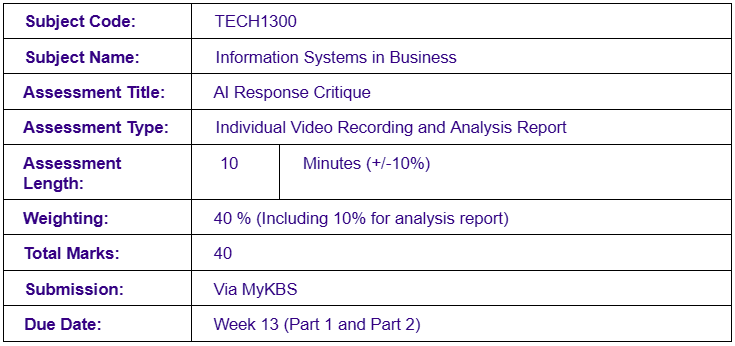
Your Task
You will critically evaluate a ChatGPT-generated response on an e-Commerce system and present your analysis through an individual video recording and a written report.
Assessment Description
This assessment evaluates your ability to design effective prompts, critically engage with ChatGPT generated responses, and communicate your understanding of e-Commerce systems such as Shopify, WooCommerce, Amazon, or others. These platforms offer distinct features to meet diverse business needs.
You are required to create effective prompts for the topics listed below and use ChatGPT to explore them. You will then critically analyse the AI-generated content, evaluate its accuracy and usefulness, compare it with academic and professional sources, and integrate your insights into a structured analysis report. Finally, you will present your findings in a professional video presentation
This assessment aims to achieve the following subject learning outcomes:
- LO2: Illustrate how information systems are used to perform routine business activities in alignment with business strategies.
- LO3: Critique the ethical, social, privacy and security issues related to information systems used in organisations.
- LO4: Document and critically communicate the use of information systems in business using software development lifecycles and requirement gathering techniques.
Assessment Instructions
1. Formulate effective prompts for the given topics then use ChatGPT to receive responses for those prompts.
2. Read and analyse the response from ChatGPT. Identify the main points and key insights provided.
3. Critically evaluate the ChatGPT responses as per the following criteria:
- • Is the information accurate and complete?
- • Are any important issues missing or oversimplified?
- • How does it compare with academic or industry sources?
- • Would it be useful in a real business decision-making context?
- • Does it include bias or unsupported assumptions?
4. Develop a cohesive argument that integrates your findings from ChatGPT responses with insights from scholarly sources (such as journal articles, books, textbooks, conference papers, and reputable industry reports) and non-scholarly sources (including blog posts, articles, company websites, case studies, and news articles). Be sure to support your analysis with 5 scholarly or professional sources.
5. Document your argument, evaluation, and critical analysis into a Word document as the preparation for your video presentation in Part 2.
6. Include an appendix with your ChatGPT prompt(s) and the full response(s).
Part 1: Analysis Report
After developing your effective prompts and receiving the responses from ChatGPT, you are required to write an analysis report of 800 words that not only summarises but also critically evaluates the AI generated content. You should go beyond description and clearly express your judgement, insights, and ability to integrate multiple sources of information.
You must use the following topics to create effective prompts:
- 1. Using e-Commerce systems to support routine business activities.
- 2. Aligning business strategy with e-Commerce platforms like Shopify, Amazon, or WooCommerce.
- 3. Ethical, social, privacy and security concerns in e-Commerce transactions and user data handling.
- 4. Applying the Software Development Life Cycle (SDLC) in e-Commerce System Development
- 5. Gathering user requirements techniques for e-Commerce systems.
- 6. Evaluating the impact of trending technologies such as AI, Cloud, or Big Data in e-Commerce systems operations.
Note:Topics may be slightly rephrased to better align with your chosen prompt focus; however, they must maintain clear relevance to e-Commerce systems and support the achievement of the intended learning outcomes.
Part 2: Video Presentation
Create a well-structured video presentation (10 minutes) based on your analysis report and responses from ChatGPT in Part 1. This is your opportunity to communicate broader insights, critical reflections, and your understanding of how e-Commerce systems operate and are evaluated using GenAI. Please use the following structure to organise your presentation (MS PowerPoint is recommended).
Cover Page (1 Slide):
- • The assessment title, your full name, student ID and date of presentation.
Approach & GenAI Use (2 Slides):
- • Briefly explain how you created effective prompts and used ChatGPT to generate responses for the given topics.
Summary of Findings (3 Slides):
- • How ChatGPT explained business operation processes, and whether the responses aligned with your understanding of e-Commerce.
- • Mention whether ChatGPT adequately addressed ethical challenges concerns, and what limitations or risks you identified.
- • Include how ChatGPT explained SDLC models and requirement gathering techniques, and whether the responses were accurate or lacked depth.
Real-World Connections (2 Slides):
- • Show how the insights from ChatGPT analysis apply to real e-Commerce platforms or business scenarios. Connect the findings to how companies like Shopify, Amazon, or WooCommerce manage order fulfilment, handle data privacy, implement AI, or align with business strategy.
Evaluation of ChatGPT (1 Slide):
- • Summarise the strengths and weaknesses of the ChatGPT responses.
Conclusion (1 Slide):
- • Discuss your final takeaways and how this experience shapes your understanding of GenAI and e-Commerce systems in modern business.
References
- • Ensure that you appropriately reference at least 5 sources or materials used in your presentation. You can use any referencing and citation style as long as they are consistent across the entire assessment.
Appendix
- • Provide screenshots or tables of your prompts and the ChatGPT responses.
Note: DO NOT copy responses from the ChatGPT. Instead, you need to analyse the responses and rephrase them for your presentation slides.
Presentation Tips:
- • Your face must be visible throughout the video recording.
- • The sound quality must be such that your voice is clearly audible.
- • Ensure background noise and interruptions are minimal.
- • Incorporate the slides throughout the recording.
- • Avoid the reading of notes or slides by talking instead to the camera.
- • Creativity is important: it’s not just what you say but how you say it that matters.
- • Proofread your slides to make certain they are free of errors and inconsistencies.
- • Your presentation and slides must reflect high standards of business professionalism.
Recording and Submission
- • Kaltura: You can record the video presentation using this tool and submit the recording after reviewing. Click the below link to learn how to record using Kaltura:
- • Zoom: It is our teaching and learning tool and you can choose to record on your computer so that you can get the recording file in MP4 format to upload for submission in Kaltura. Click the below link to learn how to upload recorded video to Kaltura:
- • Turn on your webcam so we can see you to assess your presentation skills.
- • You MUST host your video recording file in Kaltura only using MyKBS portal (using any other video hosting platforms will NOT be considered for marking).
Note: Ensure you submit your video presentation via Kaltura, and upload your analysis report and PowerPoint slides as document files on Moodle.
Important Study Information
Academic Integrity and Conduct Policy
KBS values academic integrity. All students must understand the meaning and consequences of cheating, plagiarism and other academic offences under the Academic Integrity and Conduct Policy.
Please read the policy to learn the answers to these questions:
- • What is academic integrity and misconduct?
- • What are the penalties for academic misconduct?
- • How can I appeal my grade?
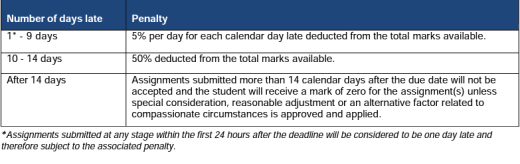
Late submission of assignments (within the Assessment Policy)
Length Limits for Assessments
Penalties may be applied for assessment submissions that exceed prescribed limits.
Study Assistance
Students may seek study assistance from their local Academic Learning Advisor or refer to the resources on the MyKBS Academic Success Centre page. Further details can be accessed at
Submission Requirements
All assessments including draft copies must be written and submitted in English. The use of translation tools is not permitted.
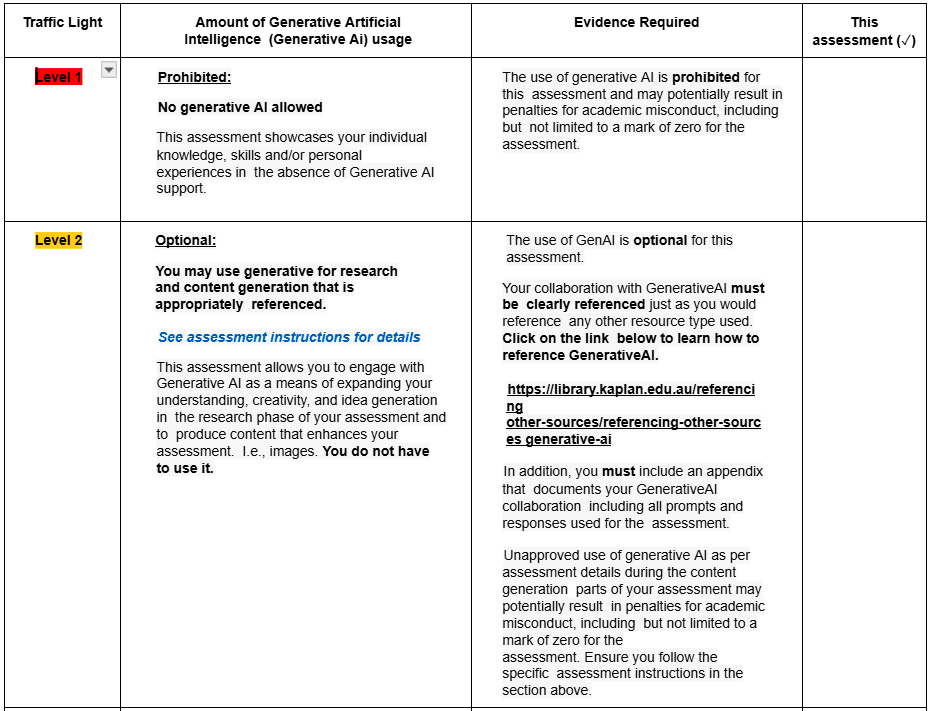
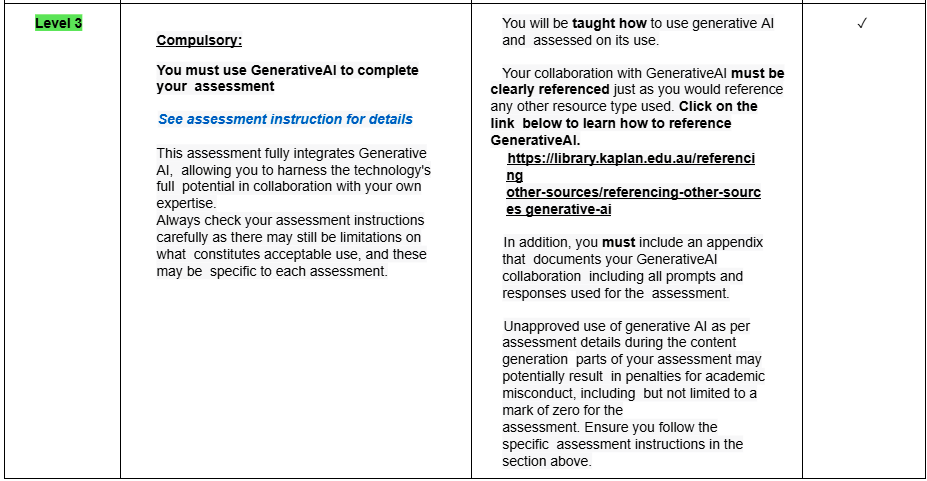
Generative AI Traffic Lights
Please see the level of Generative AI that this assessment has been designed to accept:
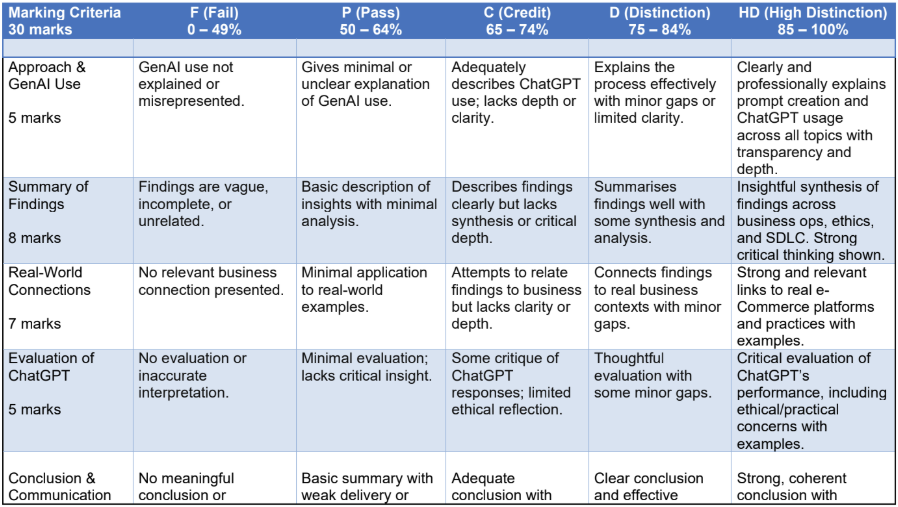
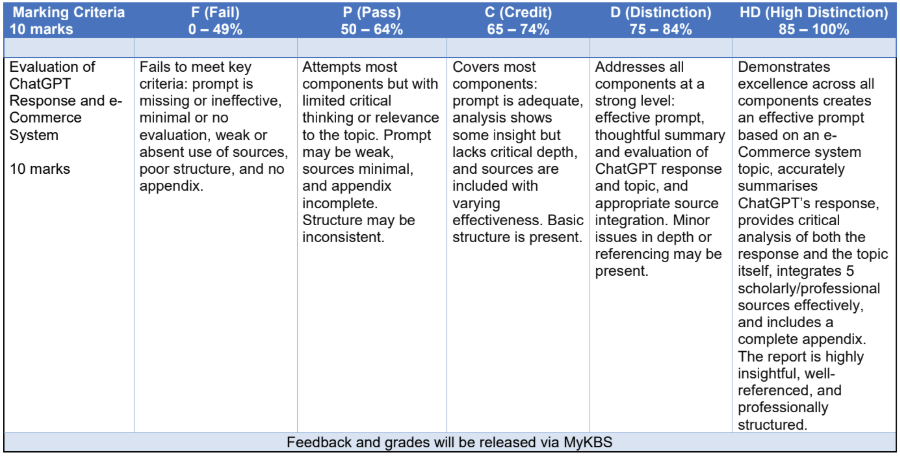
Assessment Marking Guide: Part 1 Analysis Report Marking Rubric
Assessment Marking Guide: Part 2 Video Presentation Marking Rubric